One Beach, One Story · Whitehaven Beach, Australia · October 2026 · 4 min
Whitehaven Beach: The 98% Silica Sand, and the Hubble Telescope Story That Isn't True
The sand is real, the purity is real, and nobody is sure how it got there. The part about NASA building a telescope lens out of it falls apart on the word lens.
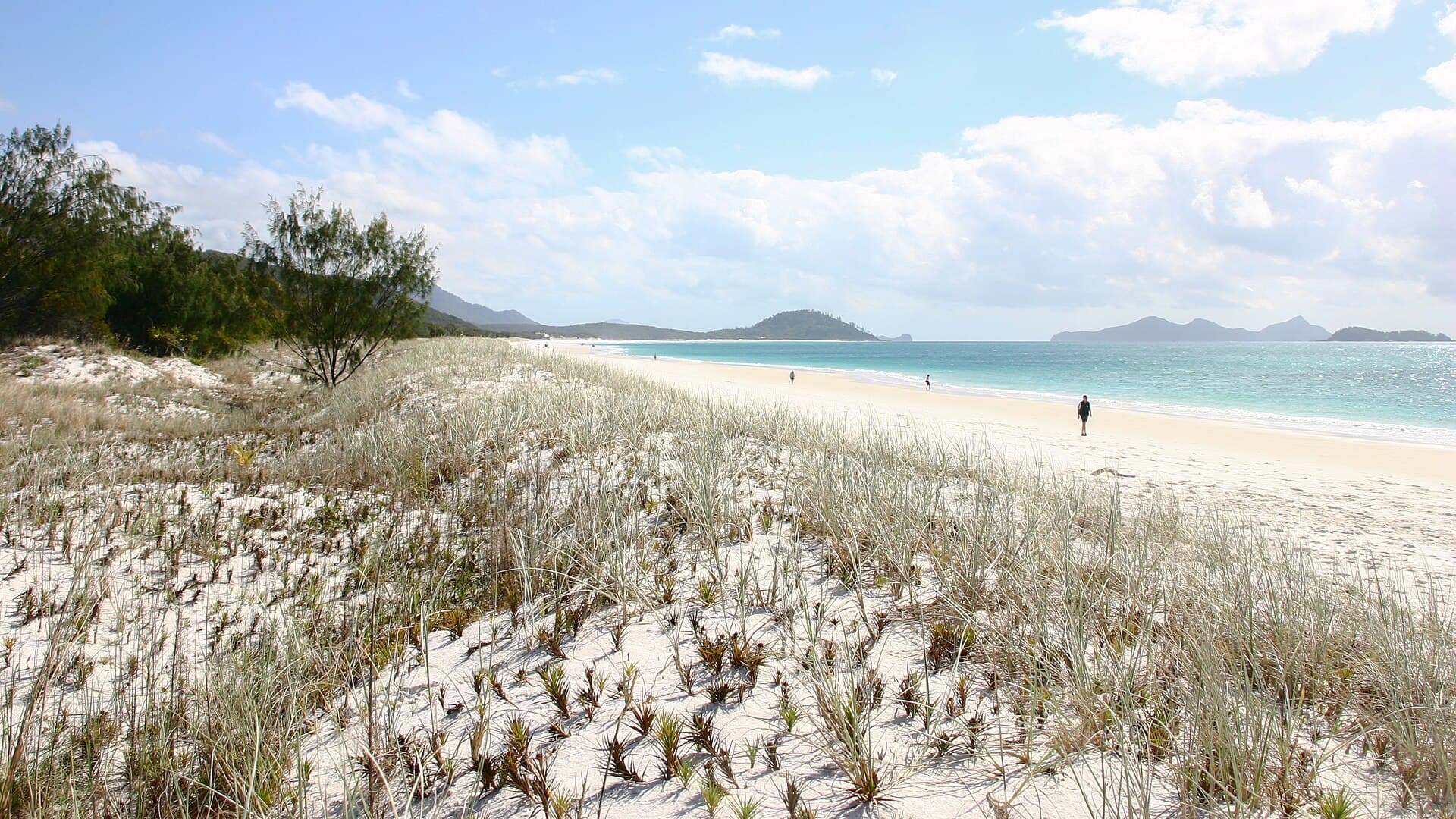
Whitehaven Beach runs along Whitsunday Island in Queensland, in the Great Barrier Reef: about seven kilometres of white sand by Wikipedia's count, reached only by boat, seaplane or helicopter from Airlie Beach or Hamilton Island. It tops our Australia list, and it is the beach of a hundred thousand screensavers. Its sand is the story.
98 per cent silica
Whitehaven's sand is 98 per cent pure silica, which Time Out says makes it whiter and softer than pretty much anywhere in the world. The odd part is that it should not be there. According to Wikipedia, silica is not present in the local rocks, so the sand is thought to have been brought to the beach by ocean currents, over millions of years. It is a guess, and Wikipedia says so: the word it uses is surmised.
98%
silica in Whitehaven's sand
Wikipedia and Time Out. The local rocks contain none, so the sand came from somewhere else.
What the sand does
It holds far less of the sun's heat than ordinary sand, so you can walk on it barefoot on a hot day. It is so fine it can damage phones and cameras. Wikipedia adds that it can be used to polish tarnished jewellery, which is the most practical thing anyone has ever said about a beach.
The Hubble story
You will meet this one on social media: the sand is so pure that NASA used it to make the lens of the Hubble Space Telescope. One post goes further, and has the Australian government letting NASA take tons of it.
NASA describes Hubble's optics differently. The telescope uses a mirror-based optical system, two mirrors in a Cassegrain design, and both the primary and secondary mirrors are made of a high-silicon Ultra-Low Expansion Glass developed by Corning Glass Works. There is no main lens to make. We found no NASA or government source that links Whitehaven's sand to the telescope at all.
The sand is famous enough without it. The telescope does not even have the lens.
The name
The Ngaro people lived in the area for thousands of years before Europeans arrived. The English name came in 1879 from Staff Commander E. P. Bedwell, the Admiralty surveyor for Queensland, who borrowed it from the town of Whitehaven in Cumberland, along with a batch of other Cumberland names for the area. A beach on the Great Barrier Reef is named after a port in the north of England.
Going
We rate it Book the flight now: first on our Australia fame list, and a find no other beach has. The boat from Airlie Beach takes 30 to 60 minutes, and most day trips also stop at the Hill Inlet lookout. There are toilets at the lookout and by the South Whitehaven campground, which you book through Queensland Parks. Queensland Parks lists warnings for crocodiles, marine stingers and sharks across the national park.
Asked
- Was Whitehaven Beach sand used to make the Hubble telescope?
- We found no source for it. NASA says Hubble's optics are two mirrors made of a high-silicon Ultra-Low Expansion Glass developed by Corning Glass Works; the telescope has no main lens.
- Why is Whitehaven Beach sand so white?
- It is 98 per cent pure silica. The local rocks contain no silica, so the sand is thought to have been carried in by ocean currents over millions of years.
- Is Whitehaven Beach sand hot?
- No: it holds much less heat than ordinary sand, so you can walk on it barefoot on a hot day.
- Who named Whitehaven Beach?
- Staff Commander E. P. Bedwell, the Admiralty surveyor for Queensland, in 1879, after the town of Whitehaven in Cumberland, England.
The beaches in this post
- Whitehaven BeachBOOK THE FLIGHT NOW